
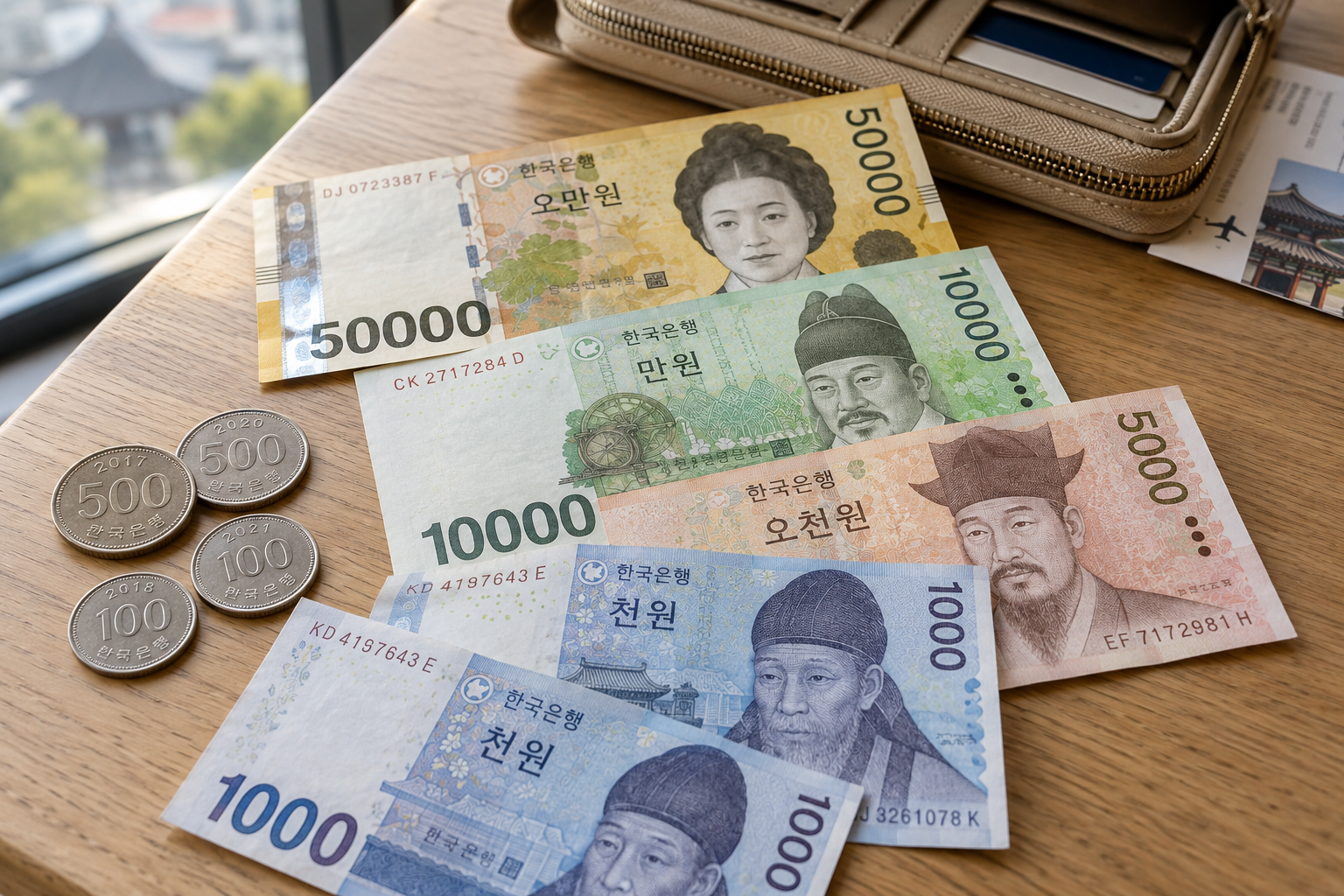
If you’re planning a trip to South Korea, you may be wondering whether you need to carry cash or can pay for everything with a credit card.
The short answer: You can use cards for most everyday purchases, but carrying some Korean won is still a good idea.
Hotels, restaurants, cafés, convenience stores, department stores, and many other businesses accept cards. However, some market vendors and street-food stalls prefer cash, and foreign-issued cards do not work at every payment terminal.
You may also need cash to recharge a physical transportation card.
A little preparation gives you more flexibility—and helps you avoid searching for an ATM when you need to pay.
Can I Use a Foreign Credit Card in Korea?
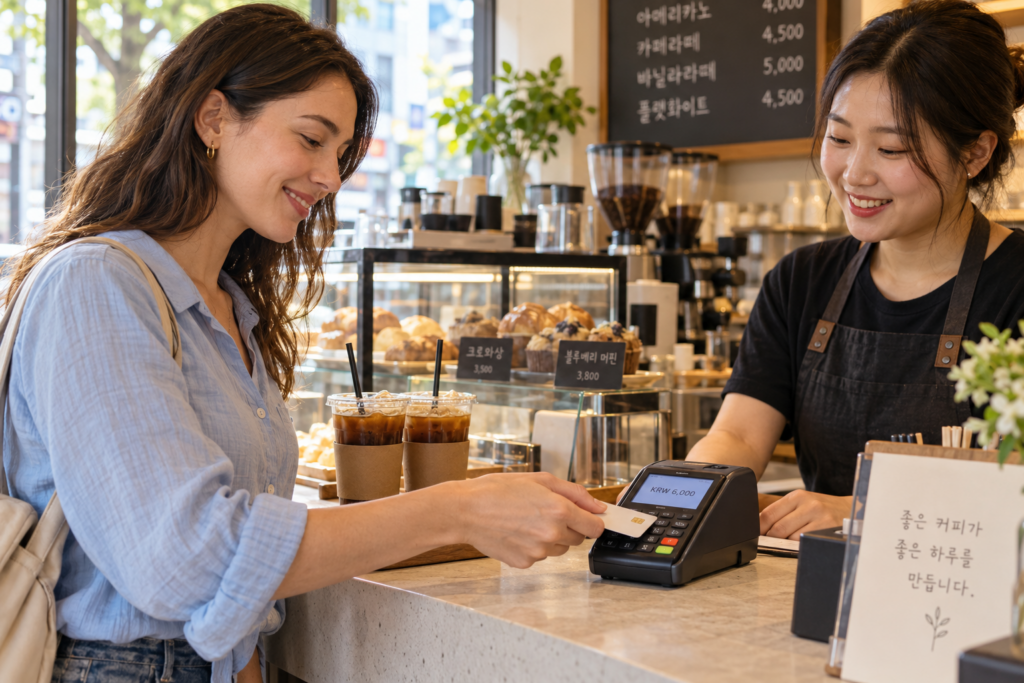
In most cases, yes.
Major international payment networks such as Visa and Mastercard are widely accepted in South Korea. American Express is also accepted at many businesses, although acceptance varies by merchant.
You can generally use a foreign credit card at:
- Hotels
- Department stores and shopping malls
- Many restaurants and cafés
- Convenience stores
- Beauty and retail stores
- Many tourist attractions
However, accepting credit cards does not guarantee that every foreign-issued card will work. A card may be declined because of the payment terminal, the merchant’s processing system, or a security restriction from your card issuer.
Bring a backup card so one declined transaction does not interrupt your plans.
My Experience Using American Express in Korea
When I visited Korea in March 2025, I used my American Express card for most of my purchases.
It worked at most of the stores, restaurants, cafés, and other businesses I visited. I had fewer problems than I expected.
There were a couple of exceptions. My Amex was not accepted when I was purchasing one ticket, and it also did not work at a self-service kiosk.
That experience is why I recommend bringing a Visa or Mastercard as a backup—even if American Express is your preferred card.
My experience may differ from yours, but it showed me that paying by card in Korea can be easy as long as you have another option available.
Check Your Card’s Fees Before Traveling
Before your trip, check whether your credit card charges a foreign transaction fee.
For example, a 3% fee on $3,000 in purchases would add $90 to your travel expenses.
A card with no foreign transaction fee can help reduce those extra costs. You do not necessarily need to apply for a new card; first, check the terms of the cards you already have.
If you plan to withdraw cash, check your debit card’s fees separately. Overseas ATM withdrawal fees, local ATM charges, and currency-conversion costs may apply.
Also make sure you can receive any security alerts or verification messages your bank may send while you are abroad.
For help staying connected, see Can I Use My U.S. Phone in Korea?.
Choose Korean Won When Paying by Card
A payment terminal may ask whether you want to pay in Korean won or your home currency.
For example, a traveler with a U.S. card may see a choice between:
- KRW — Korean won
- USD — U.S. dollars
Choosing Korean won is generally the better default.
When you select your home currency, the merchant or payment provider may convert the amount using a service called Dynamic Currency Conversion, or DCC. That conversion can include an additional markup.
Choosing KRW lets your card network and issuer handle the conversion under your card’s terms. Any foreign transaction fee charged by your issuer may still apply.
Remember this simple rule: Choose the local currency—Korean won—when paying in Korea.
When Is Cash Useful in Korea?
Even though cards are widely accepted, there are several situations where cash can make things easier.
Traditional Markets and Street Food
Some vendors accept cards, while others prefer or require cash.
If you plan to browse a traditional market or buy snacks from small street-food stalls, bring some Korean won rather than assuming every vendor has a card terminal.
Smaller notes can be convenient for inexpensive purchases.
Recharging a Physical T-Money Card
A physical T-money card is useful for riding local buses and subways.
However, you should not assume that you can recharge it with a foreign credit card at every convenience store or station machine. Keeping Korean won available is a practical way to avoid problems.
The card itself and the money loaded onto it are separate purchases.
For more information, read How to Use T-Money in Korea.
Small Businesses and Backup Payments
Cash can also help when a small business does not accept your card or a payment terminal is temporarily unavailable.
You probably will not use it for every purchase, but having a backup is reassuring.
How Much Cash Should You Carry?
You usually do not need to carry a large amount.
As a practical starting point, consider keeping ₩50,000 to ₩100,000 per person available, then adjust based on your plans.
This is a suggested reserve, not a required daily budget.
You may want more if you plan to shop at markets, buy street food frequently, or pay mainly in cash. You may need less if most of your spending will be at hotels, restaurants, and larger stores.
Try to keep a few smaller notes, such as ₩1,000, ₩5,000, and ₩10,000, for small purchases.
Avoid carrying your entire travel budget in cash. Keep your backup card and some emergency money separate from your everyday wallet.
Where Can You Get Korean Won?
You have several options after arriving in Korea.
Airport Currency Exchange Counters
Exchanging a small amount at the airport can be convenient, especially if you want cash before continuing to your accommodation.
Compare the exchange rate and any fees before completing the transaction. The most convenient counter may not offer the best overall value.
Banks and Authorized Exchange Offices
You can exchange supported foreign currencies at banks and authorized currency exchange offices.
Exchange offices in tourist areas may be convenient, while bank services depend on opening hours and the branch.
Bring your passport, as identification may be required. Check which currencies the location accepts before making a special trip.
ATMs That Accept International Cards
You may be able to withdraw Korean won using your debit card at an international-compatible ATM.
Look for signs such as “Global ATM” and check whether the machine supports your card’s network. Not every Korean ATM accepts foreign-issued cards.
Before confirming a withdrawal, review the fees shown on the screen. Your own bank may charge additional fees.
If the ATM offers to convert the withdrawal into your home currency, review that offer carefully. Choosing to withdraw in Korean won without the ATM’s conversion is generally the better default.
Use a debit card intended for cash withdrawals. Withdrawing money using a credit card may be treated as a cash advance, with separate fees and interest.
What If Your Card Does Not Work?
A declined card does not necessarily mean there is a problem with your account.
Try these steps:
- Use your backup card.
- Ask whether the staff can process the payment at another terminal.
- Check your banking app for a security alert.
- Pay with cash if the business accepts it.
- Contact your card issuer if the problem continues.
At restaurants, a kiosk may reject a card even when a staffed counter can accept it.
However, some kiosks do not accept cash. Ask a staff member whether there is another way to order or pay.
For help with kiosks, table tablets, and ordering from staff, see How to Order Food in Korea When You Don’t Speak Korean.
What About Transportation Payments?
Transportation payments work a little differently from ordinary shopping.
Local Buses and Subways
A rechargeable transportation card such as T-money is convenient for local public transportation.
Keep some cash available for recharging a physical card. Mobile transportation-card options have their own device and payment requirements, so check compatibility before relying on one.
KTX and Other Intercity Trains
KTX and other intercity trains require separate tickets. You do not normally board them by tapping your regular T-money card.
Check the booking service’s payment options when purchasing your ticket.
Taxis
Many taxis accept cards, but payment options can vary by vehicle and booking method.
When using a taxi app, check whether you will pay through the app or directly to the driver. Keep a backup payment method available.
For help choosing between trains, subways, buses, and taxis, read Getting Around Korea.
For help choosing between trains, subways, buses, and taxis, read our Getting Around Korea guide.
Do You Need Cash for Shopping?
At larger stores, cards are generally convenient.
For example, department stores, beauty retailers, and many souvenir shops accept major credit cards. Still, bring a backup because foreign-card acceptance can vary.
If you plan to shop at Olive Young, compare product sizes, promotional bundles, and the total price before purchasing.
Read What to Buy at Olive Young in Korea for shopping ideas and practical tips.
For gifts beyond beauty products, see Best Souvenirs to Buy in Korea.
Do You Need Cash for Tips?
Tipping is not normally expected at everyday Korean restaurants and cafés.
You generally pay the stated amount without adding the restaurant tip you may be accustomed to at home.
This means you usually do not need to carry extra cash specifically for tipping.
For more details, read Do You Tip in Korea?.
My Recommended Payment Setup
For a typical trip to Korea, I recommend bringing:
- One primary card: Preferably a card with no foreign transaction fee
- One backup card: Ideally from a different payment network
- Some Korean won: For small purchases, transportation-card top-ups, and backup payments
- A debit card: If you plan to withdraw cash
- A transportation card: If you will use local buses and subways
Keep your backup card separate from your main wallet when possible.
Before leaving, check your cards’ fees, international-use settings, and how to contact your bank from abroad.
Final Thoughts
You do not need to pay for everything in cash when visiting Korea.
Cards work well for most everyday purchases, and I personally had a good experience using American Express during my March 2025 trip.
However, no single payment method works everywhere.
Bring a primary card, a backup card, and a modest amount of Korean won. If you plan to use a physical T-money card, keep cash available for recharging it.
With a few payment options ready, you can spend less time worrying about transactions and more time enjoying your trip.