
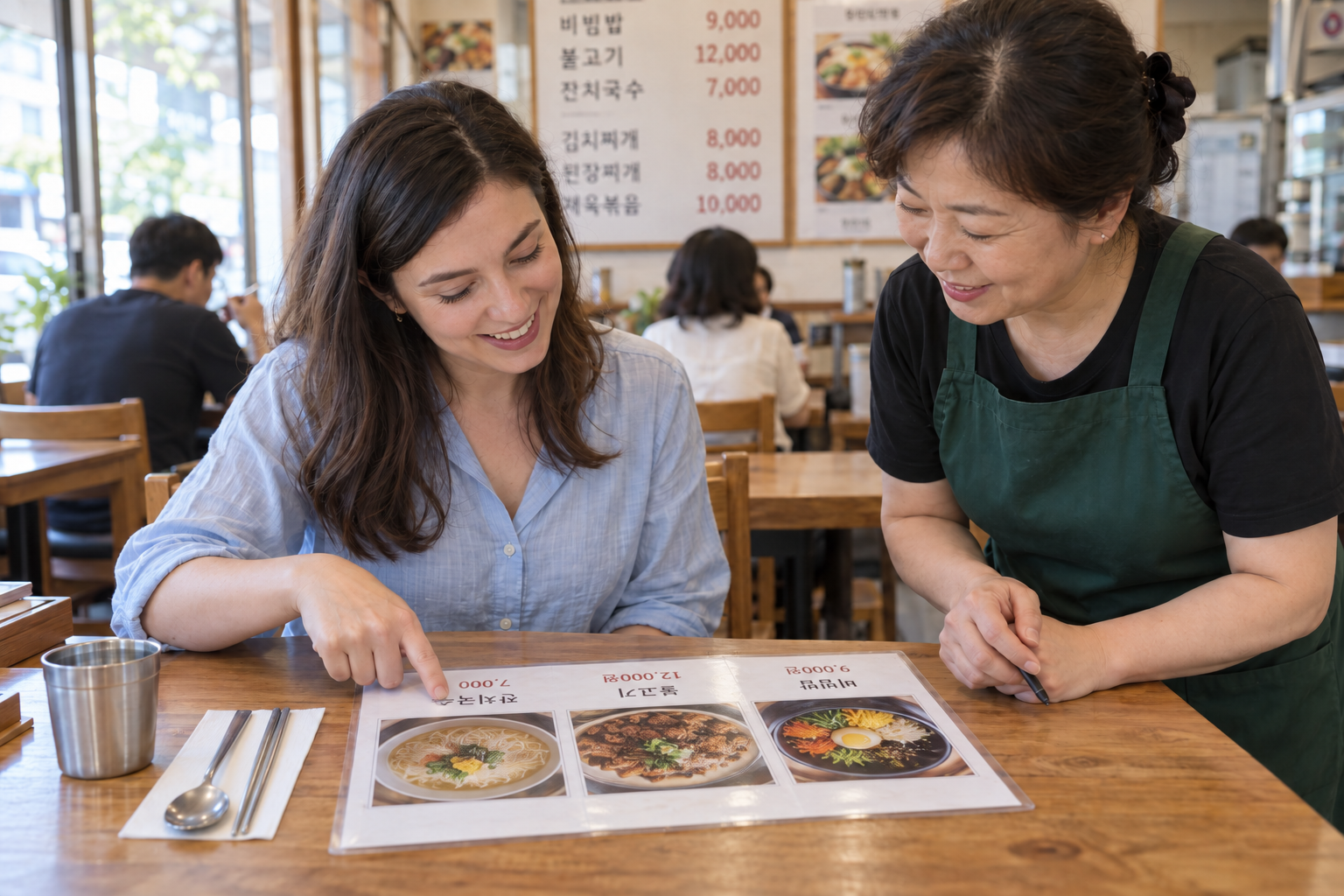
One of the best parts of traveling in South Korea is the food.
But walking into a Korean restaurant for the first time can feel intimidating if you don’t speak Korean. The menu may be entirely in Korean, the server may not speak much English, or you may find yourself standing in front of a touchscreen kiosk wondering what to press.
The good news is that you do not need to speak Korean to eat well in Korea.
Depending on the restaurant, you may order from a server, a touchscreen kiosk, a tablet at your table, or even a QR code. When there is no English menu, your smartphone, menu photos, and a few simple Korean phrases can go a long way.
There are also a few things about Korean restaurants that may be unfamiliar to American travelers—from complimentary banchan (side dishes) to utensil drawers hidden under the table.
Here’s what to know before your first meal.
Don’t Be Afraid to Try a Local Korean Restaurant
You don’t have to limit yourself to restaurants with English signs or English-speaking staff.
Restaurants in popular tourist areas may have English menus or menus with photos, but smaller neighborhood restaurants may have little or no English.
That doesn’t mean you can’t eat there.
Pointing to a menu item or photo is perfectly fine. One simple Korean phrase can be especially useful:
“Igeo juseyo” (이거 주세요)
“This one, please.”
Point to the dish you want while saying it.
You don’t have to pronounce the Korean name of every dish perfectly. In many situations, pointing and saying “Igeo juseyo” is enough.
First, Figure Out How You’re Supposed to Order
One of the first differences American travelers may notice is that you don’t always give your order directly to a server.
Depending on the restaurant, you might:
- Order from a server
- Use a touchscreen kiosk
- Order from a tablet at your table
- Scan a QR code and order from your phone
So if you sit down and nobody immediately comes over to take your order, don’t assume you’re being ignored.
Look around first.
There may be a tablet, QR code, kiosk, or call button nearby.
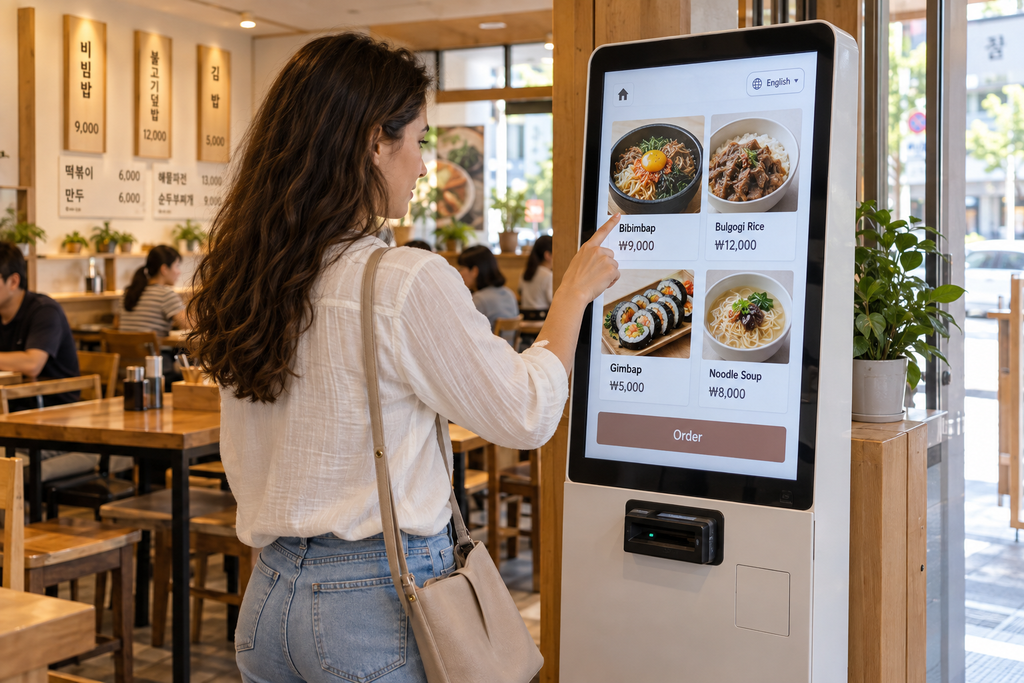
How to Use a Restaurant Kiosk in Korea
Touchscreen kiosks are common at fast-food restaurants, cafés, food courts, and many casual restaurants.
Before you start ordering, look for:
English
or a globe/language icon.
If English is available, switch languages before you begin.
The process is usually familiar:
Choose your food → select options → review your order → pay
If there is no English option, your phone can help.
A camera-translation feature can be particularly useful because you can point your phone at the Korean text on the screen instead of typing every word manually.
And don’t feel pressured if someone is waiting behind you. Step aside for a moment if necessary, figure out what you want, and then return to the kiosk.
Ordering From a Tablet at the Table
Some Korean restaurants have touchscreen tablets sitting on or attached to the table.
Instead of giving your order to a server, you select your food on the tablet and send the order electronically.
Look for an English or language option first.
If there isn’t one, menu photos and camera translation can help you identify the dishes.
You may also be able to use the same tablet later to order additional food or drinks.
You May Also Order by QR Code
Some restaurants allow customers to scan a QR code at the table and order directly from a smartphone.
The exact system varies by restaurant. Some Korean restaurant and reservation platforms have expanded foreign-language support, making these systems easier for international travelers to use.
If the QR ordering page doesn’t work or you aren’t sure what to do, simply show the screen to a staff member and ask for help.
What If the Menu Is Only in Korean?
Your phone becomes one of your best tools.
Instead of translating every menu item individually, use a camera-translation feature to view the menu through your phone.
Photos can also help.
If you saw a dish in a restaurant listing, review, or photo online, show the picture to the server and say:
“Igeo juseyo.” — “This one, please.”
In many situations, that’s all you need.
Is It Spicy?
Not all Korean food is spicy, but some dishes can be much hotter than an American traveler expects.
A useful question is:
“Maeweoyo?” (매워요?)
“Is it spicy?”
If you want to ask whether the food can be made less spicy, you can say:
“An maepge haejuseyo.” (안 맵게 해주세요.)
“Please make it not spicy.”
Keep in mind that some dishes use a broth or sauce that has already been prepared, so the restaurant may not always be able to change the spice level.
What If You Have a Food Allergy?
If you have a serious food allergy, don’t rely only on pictures or automatic translation.
Ingredients such as shellfish, seafood, sesame, soy, wheat, eggs, or nuts may be used in sauces, broths, marinades, or side dishes even when they aren’t obvious.
Before traveling, consider saving a clearly translated message on your phone explaining exactly what you cannot eat.
Show the allergy message to restaurant staff before you order.
For severe allergies, researching restaurants ahead of time is safer than relying entirely on translation after you arrive.
What Are All Those Small Side Dishes? Understanding Banchan
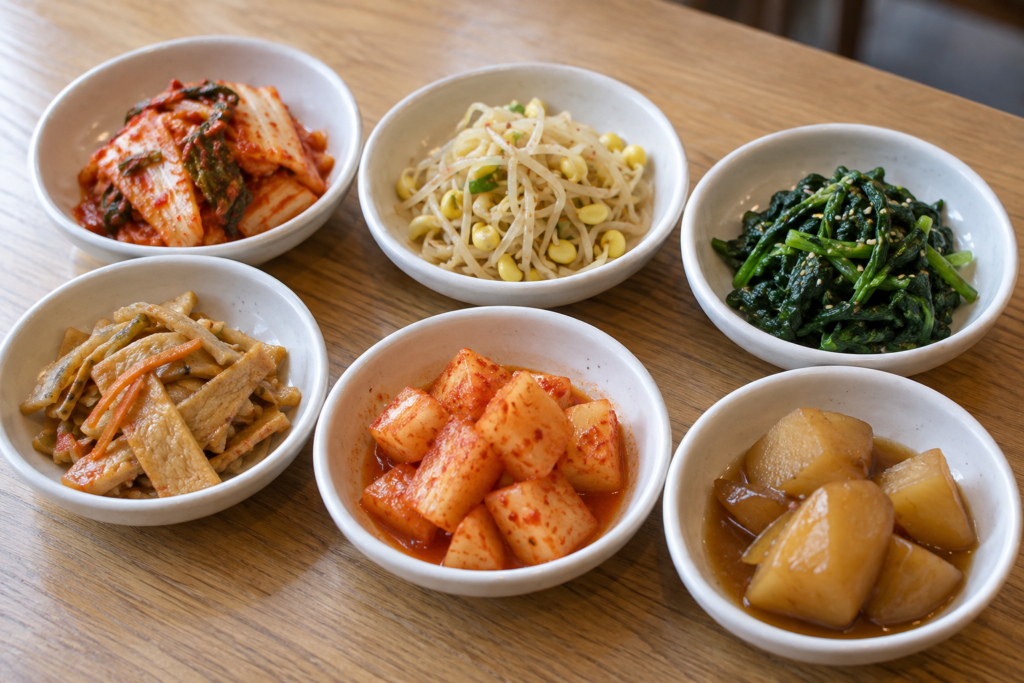
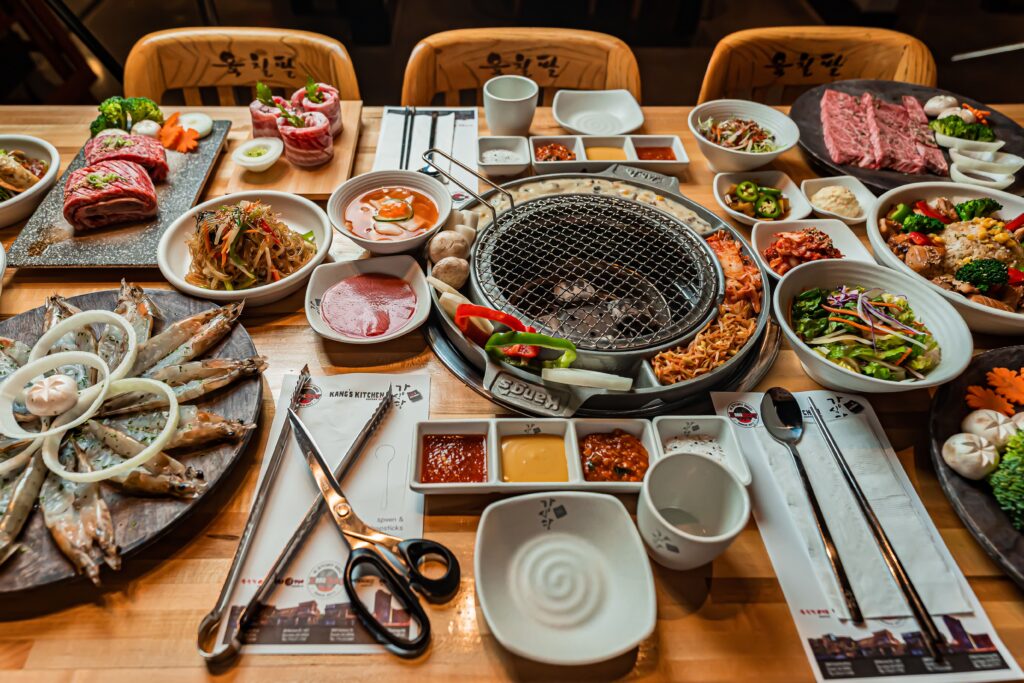
If it’s your first time eating at a traditional Korean restaurant, you may be surprised when several small dishes suddenly appear on your table.
You didn’t order them.
So what are they?
They’re called banchan (반찬)—small side dishes traditionally served alongside a Korean meal.
Depending on the restaurant and what you order, banchan might include:
- Kimchi
- Seasoned vegetables
- Bean sprouts
- Pickled radish
- Seaweed
- Small salads
- Stir-fried or braised vegetables
- Other seasonal side dishes
The selection varies widely depending on the restaurant and the meal.
In many Korean restaurants, basic banchan are included with your meal rather than ordered individually like side dishes at many American restaurants.
So if several little plates arrive that you didn’t order, don’t worry—you probably haven’t accidentally ordered extra food.
They’re part of the Korean dining experience.
Can You Get More Banchan?
Often, you can get more of certain basic banchan.
At some restaurants, you can ask a staff member for another serving.
At others, you’ll find a self-service banchan bar where you can refill certain side dishes yourself.
However, policies vary by restaurant, and you shouldn’t assume that every dish on the table comes with unlimited free refills.
If you’re unsure, simply ask.
And at a self-service bar, take only what you think you’ll eat. You can always go back for more.
First-time traveler tip: If several small dishes arrive before or with your meal, they’re probably banchan—not separate appetizers that you accidentally ordered.
What Does “Service” Mean in a Korean Restaurant?
Here’s another Korean restaurant custom that can be especially confusing for Americans.
Occasionally, a restaurant may bring you an extra dish, drink, dessert, or other item that you didn’t order.
A staff member might place it on your table and say:
“Service” (서비스)
In this situation, don’t confuse the word with a service charge.
In Korea, when a restaurant says an extra item is “service,” it generally means the restaurant is giving it to you for free.
The closest American expression would be:
“It’s on the house.”
What you receive varies by restaurant. It could be a small dish, an appetizer, a drink, dessert, or another complimentary item.
So if a server brings something you didn’t order and tells you “service,” you generally aren’t expected to pay for that item.
Banchan and “Service” Aren’t Exactly the Same Thing
There is an important difference.
Banchan are the small side dishes that traditionally accompany a Korean meal.
“Service” is an extra complimentary item that the restaurant chooses to give you.
So you might receive your normal banchan with the meal and then, separately, receive another dish that the restaurant calls “service.”
American traveler tip: When you hear “service” in this situation, think “on the house,” not “service fee.”
Where Are the Chopsticks and Spoons?
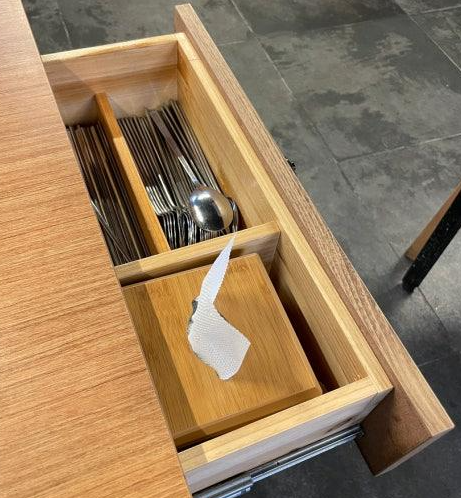
Spoon and chopsticks stored in a Korean restaurant table drawer
This is another thing that can confuse first-time visitors to Korea.
You sit down and look around the table:
Where are the chopsticks and spoons?
At many Korean restaurants, they’re already at your table—you just can’t see them.
Look along the side or underneath the tabletop.
Many restaurant tables have a built-in utensil drawer that you can pull open. Inside, you’ll commonly find stainless-steel chopsticks and spoons, and sometimes napkins as well.
So if there are no utensils sitting on top of the table, check the side of the table before asking the server.
This setup is common at many casual Korean restaurants, including barbecue restaurants, soup restaurants, and other local eateries.
Korean meals commonly use both a spoon and chopsticks. The spoon is especially useful for rice and soup, while chopsticks are used for side dishes and other foods.
First-time traveler tip: Can’t find the utensils? Check the side of the table. They may be hiding in a drawer right in front of you.
Water and Extra Side Dishes May Be Self-Service
Another difference you may notice is the self-service area.
Some restaurants bring water and side dishes directly to your table.
At others, you may be expected to get certain things yourself, such as:
- Water
- Extra banchan
- Napkins
- Utensils
Look around for a self-service station if you need something and the server doesn’t automatically bring it.
This is normal at many casual Korean restaurants and doesn’t mean you’re receiving poor service.
How Do You Call the Server?
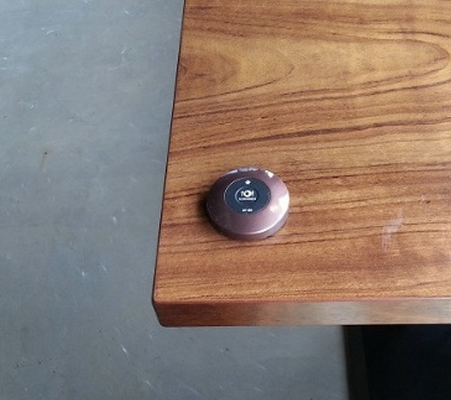
Call button used to request a server at a Korean restaurant
In the United States, you may be used to your server checking on your table several times during a meal.
In Korea, things can work a little differently.
At many Korean restaurants, you may find a small call button or bell right on the table. Instead of trying to get a server’s attention by waving or waiting for someone to come by, simply press the button when you need something.
The button may say:
호출 (hochul) — Call
벨 (bell) — Bell
Pressing the call button is completely normal and is not considered rude. The restaurant put it there specifically so customers can call a server when they need assistance.
After you press it, you may hear a bell or chime, and a server will usually come to your table.
First-time traveler tip: Before trying to wave down a server, check the edge or corner of your table for a call button.
How Do You Pay at a Korean Restaurant?
Don’t automatically wait at the table for someone to bring you a check.
At many Korean restaurants, you pay at the counter near the entrance or exit after you’re finished eating.
Other restaurants may have you pay when you order, particularly when using a kiosk, tablet, or QR ordering system.
If you’re unsure, walking toward the counter with your card will usually make your intention clear.
Do You Tip at Restaurants in Korea?
Generally, no.
Tipping is not normally expected at Korean restaurants.
For Americans, this may feel unusual because you’re accustomed to adding a percentage to the restaurant bill.
In Korea, you generally pay the amount shown without adding the typical 15–20% restaurant tip you might leave in the United States.
And remember: if the restaurant tells you an extra dish is “service,” that doesn’t mean they’re asking for a service charge or tip. It means the item is complimentary.
Related Guide: Do You Tip in Korea?
How to Make Restaurant Reservations in Korea
Popular restaurants in Korea may require reservations or use digital waitlist systems, especially during busy dining hours.
This can sometimes be challenging for international travelers because certain Korean services may require local account information or verification.
However, services for international visitors have improved, and some restaurant reservation platforms now provide foreign-language interfaces and support for travelers without a Korean phone number.
If you’re planning to visit a particularly famous restaurant, check its reservation or waitlist process before you arrive.
Useful Korean Phrases for Restaurants
You don’t need to memorize dozens of Korean sentences before your trip.
These few can make eating out much easier:
| Korean | Pronunciation | Meaning |
|---|---|---|
| 이거 주세요 | Igeo juseyo | This one, please |
| 매워요? | Maeweoyo? | Is it spicy? |
| 안 맵게 해주세요 | An maepge haejuseyo | Please make it not spicy |
| 물 주세요 | Mul juseyo | Water, please |
| 감사합니다 | Gamsahamnida | Thank you |
Don’t worry if your pronunciation isn’t perfect.
Pointing at the menu while using a simple phrase can make your meaning much clearer.
Final Tips for Your First Korean Restaurant
Eating at a Korean restaurant without speaking Korean may seem intimidating the first time, but it usually gets much easier after you’ve done it once or twice.
Before assuming you need to speak to a server, look around the restaurant. There may be a kiosk, tablet, QR code, or call button that tells you what to do.
Keep your phone handy for translation.
If several small dishes arrive that you didn’t order, they’re probably banchan, the side dishes that come with many Korean meals.
If the restaurant brings you an additional item and says “service,” think “on the house.” It’s a complimentary extra.
If you can’t find your chopsticks and spoon, check the side of the table for a utensil drawer.
If you need water or more side dishes, look for a self-service station.
And when you’re finished eating, remember that you may need to walk to the counter to pay.
Most importantly, don’t let the language barrier stop you from trying a small local restaurant just because there isn’t an English menu.
And remember one very useful phrase:
“Igeo juseyo.”
“This one, please.”
Sometimes, that’s all you need to enjoy a great meal in Korea.