
Greetings, Age, and Everyday Manners
Visiting Korea for the first time? A few everyday customs can help you feel more comfortable when meeting people, visiting someone’s home, or sharing a meal.
You do not need to memorize a complicated set of rules. Start with a polite greeting, a small bow, and a willingness to follow your host’s lead.
One difference that may surprise American visitors is how age and relationships influence language and manners. Someone may ask your age soon after meeting you—not necessarily to judge you, but to understand how to address you.
Here is a practical guide to the customs you are most likely to encounter.
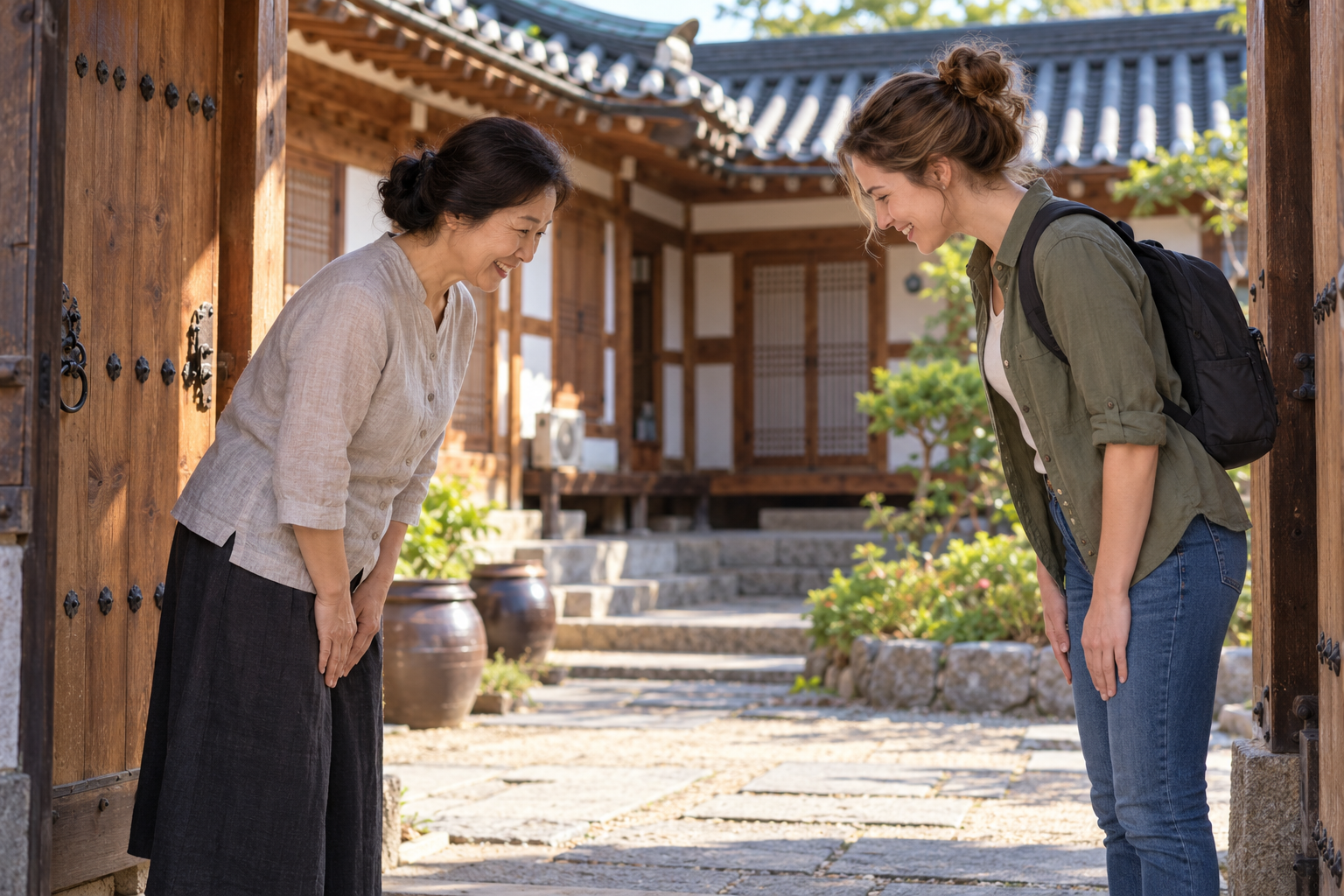
1. Say Hello with a Small Bow
A common polite greeting is:
안녕하세요 — Annyeonghaseyo
Hello.
Say it with a small bow or a gentle nod of your head. For everyday encounters, a brief, natural movement is enough. You do not need a deep ceremonial bow when entering a shop or meeting someone casually.
When someone greets you with a bow, returning a small bow is a friendly response.
Handshakes are also common, especially in business settings. If the other person offers a hand, shake with your right hand. Supporting your right forearm lightly with your left hand adds a respectful touch, particularly when greeting someone older or in a formal setting.
Visitor tip: A smile, “Annyeonghaseyo,” and a small bow are a good starting point.
2. Use Two Hands When Giving or Receiving Something
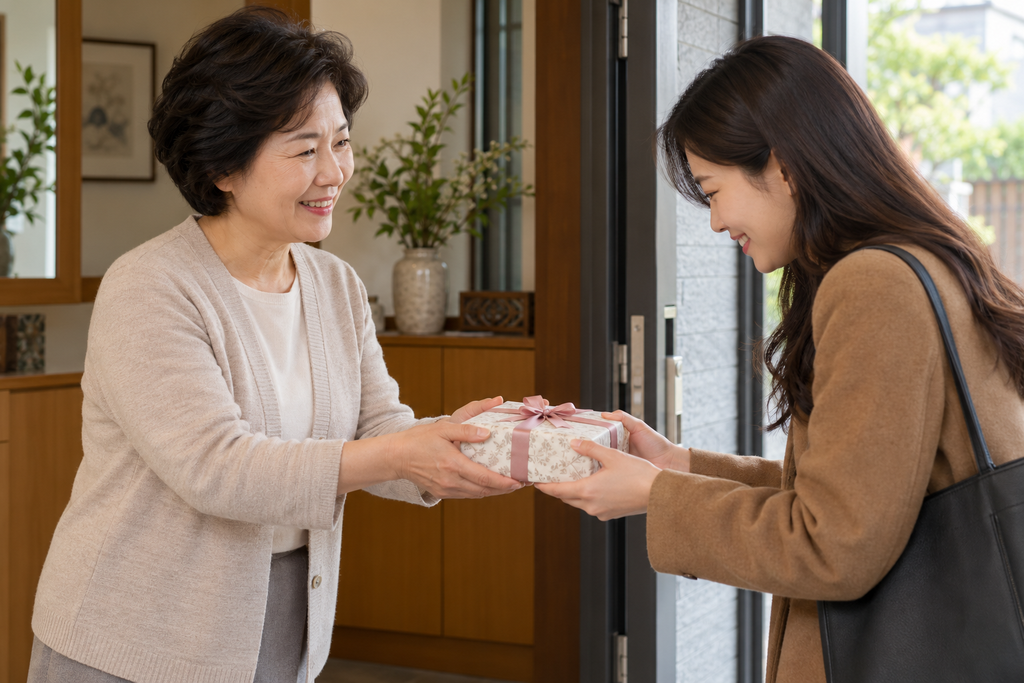
Using two hands is a familiar way to show respect in Korea.
It is especially appropriate when giving or receiving:
- A gift
- A business card
- A drink
- Money or a payment card in a personal exchange
- Something offered by an older person or a host
You can hold the item with both hands, or use your right hand while your left hand lightly supports your right wrist or forearm.
The gesture matters more in introductions, visits, and formal situations than in every quick transaction. You will also see people use one hand in busy shops or casual exchanges.
If a cashier provides a payment tray, you can place your cash or card on the tray.
Visitor tip: When someone presents something to you with both hands, receiving it with both hands is an easy way to respond politely.
3. Take Off Your Shoes Before Entering a Korean Home
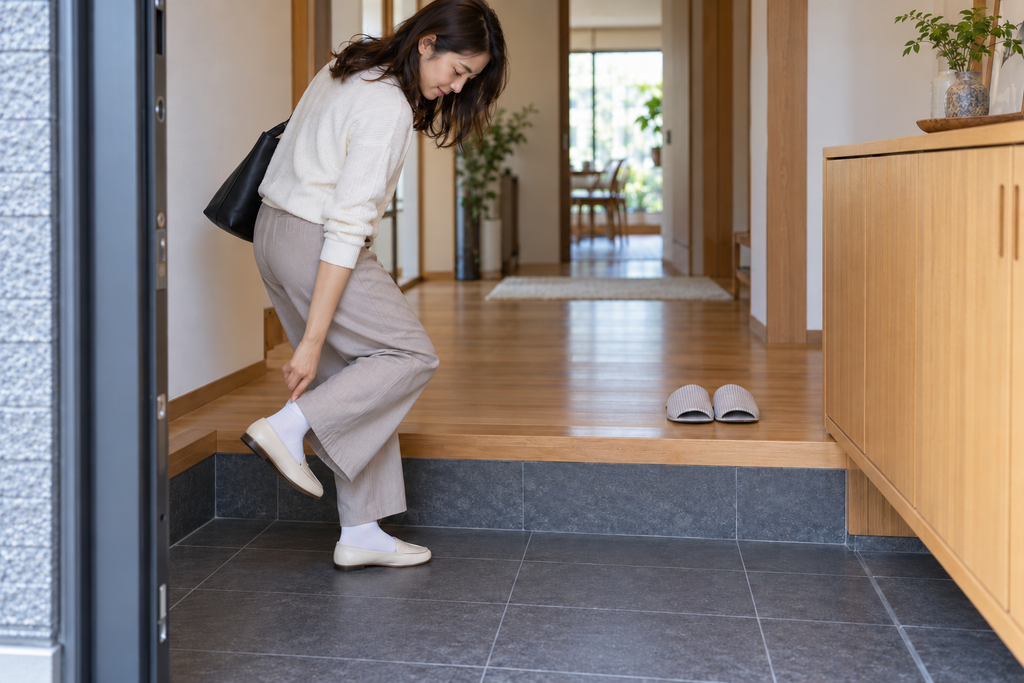
When visiting a Korean home, remove your shoes in the entrance area before stepping onto the interior floor.
Look for a lower entryway, a shoe cabinet, or shoes arranged near the door. Leave your shoes there and step into the home in socks, or use indoor slippers if your host offers them.
Some traditional accommodations, restaurants with floor seating, and certain temple spaces also require shoe removal. Other places allow shoes throughout.
Follow the signs and your host’s instructions rather than assuming that every indoor space has the same rule.
If you are unsure, ask:
“Should I take off my shoes?”
Visitor tip: Wear clean socks when visiting someone’s home, and choose shoes that are easy to remove.
4. Why Do Koreans Sometimes Ask Your Age?
In the United States, asking someone’s age shortly after meeting them can feel personal. In Korea, the question may serve a practical social purpose.
Age can help people decide:
- Which level of Korean speech to use
- How to address each other
- Whether a more formal or relaxed manner is appropriate
- How to understand their relationship within a group
Someone may ask how old you are or what year you were born, especially when making friends or joining a social group.
This does not mean every Korean will ask your age. Practices vary by person, generation, and setting. In a brief encounter at a restaurant or shop, the question may never come up.
If you prefer not to share your exact age, you can answer generally, such as “I’m in my forties,” or politely say that you prefer to keep it private.
Visitor tip: An age question may be an attempt to find the right way to speak to you rather than an intrusive personal judgment.
5. Understand the Difference Between Jondaetmal and Banmal
English can sound more formal or casual depending on word choice and tone. Korean also expresses these differences through sentence endings and vocabulary.
For visitors, two useful terms are:
존댓말 — Jondaetmal
Polite or honorific speech.
반말 — Banmal
Informal or casual speech.
This is a simplified introduction: Korean has several speech styles, and honorific language involves more than sentence endings.
Jondaetmal: The Safest Starting Point
Polite speech is generally appropriate when speaking with:
- Someone you have just met
- An older person
- A customer, teacher, or professional contact
- An adult stranger, even if they appear younger than you
For example:
안녕하세요 — Annyeonghaseyo
A polite hello.
감사합니다 — Gamsahamnida
Thank you.
You may notice that many everyday polite Korean sentences end in -요 (-yo). However, simply adding “yo” to any word does not automatically make a sentence correct or polite.
Banmal: Used in Familiar Relationships
Banmal is common among close friends, between adults and young children, and in some relationships where informal speech is understood or agreed upon.
For example:
안녕 — Annyeong
An informal hello or goodbye.
Although you may hear “Annyeong” frequently in Korean dramas, “Annyeonghaseyo” is a better greeting for an adult you do not know.
Banmal is not inherently rude. It can express warmth and closeness. However, using it too soon with an unfamiliar adult can sound disrespectful.
Visitor tip: Learn the polite version of a phrase first.
6. How Does Age Change Everyday Manners?
Age can influence how people speak and behave, but it is only one part of the relationship. Familiarity, professional position, and the setting matter too.
When the Other Person Is Older
You may notice people:
- Use polite speech and respectful forms of address
- Give or receive items with both hands
- Greet the older person first
- Wait for an elder or host to begin a more traditional meal
These gestures may be more noticeable when meeting a friend’s parents, visiting relatives, or attending a formal gathering.
When the Other Person Is Younger
Being older does not automatically mean you should use banmal.
Adults who meet for the first time often use polite speech with each other, even when there is an age difference. Speaking courteously to younger adults—including servers, shop staff, and coworkers—is a respectful default.
In an established relationship, an older person may use informal speech while the younger person continues using polite speech. In other relationships, both people remain polite or agree to speak casually.
When You Are the Same Age
People of the same age may find it easier to become casual friends. Even so, they may begin with polite speech and switch only after getting comfortable.
You might hear:
말 놓아도 돼요? — Mal noado dwaeyo?
May I speak casually?
You do not need to use this phrase yourself as a beginner. It simply helps explain why people sometimes discuss how they will speak to each other.
Visitor tip: Start politely with everyone. Being older is not permission to speak dismissively to someone younger.
7. Do You Need to Use “Oppa,” “Unnie,” or Other Korean Titles?
Korean dramas often feature relationship terms such as:
- Oppa: Used by a female speaker for an older brother or a familiar older male
- Unnie: Used by a female speaker for an older sister or a familiar older female
- Hyung: Used by a male speaker for an older brother or a familiar older male
- Noona: Used by a male speaker for an older sister or a familiar older female
These terms can extend beyond actual family relationships, but they depend on familiarity and social context.
They are not general replacements for “sir,” “ma’am,” or an unfamiliar person’s name.
As a visitor, use the name or title someone introduces themselves with. If you become friends, you can ask what they would like you to call them.
Visitor tip: You do not need to copy relationship terms from dramas to sound friendly.
8. Follow Your Host’s Lead at the Table
When eating with an older person or attending a more formal meal, it is considerate to wait for the host or elder to begin.
Casual meals among friends may be much more relaxed. Observe the group rather than worrying about every movement.
Other useful habits include:
- Use serving utensils when they are provided.
- Avoid leaving chopsticks standing upright in rice.
- Take modest portions from shared dishes.
- Ask before assuming an additional dish or refill is free.
The small dishes served alongside many Korean meals are called banchan. Learn more in What Is Banchan? Are Side Dishes Free in Korea?.
For help with menus, call buttons, utensils, and payment, read How to Order Food in Korea When You Don’t Speak Korean.
9. What If You Make a Mistake?
You are not expected to understand every Korean custom on your first visit.
A polite attitude and a willingness to adjust usually matter more than perfect technique. If someone shows you where to leave your shoes or how to do something, thank them and follow their guidance.
Two useful phrases are:
감사합니다 — Gamsahamnida
Thank you.
죄송합니다 — Joesonghamnida
I’m sorry.
If you are speaking English, you do not need to imitate Korean speech levels. A courteous tone, respectful behavior, and a few polite Korean phrases are enough to get started.
Final Thoughts
Korean etiquette becomes easier to understand when you see how it reflects relationships.
A small bow acknowledges the person you are meeting. Using two hands shows consideration. Removing shoes respects the home. Polite speech helps people communicate appropriately before they know each other well.
Age may influence these interactions, but it does not replace kindness or mutual respect.
Start politely, watch the people around you, and ask when you are unsure. You can enjoy meeting people in Korea without getting every detail right.