
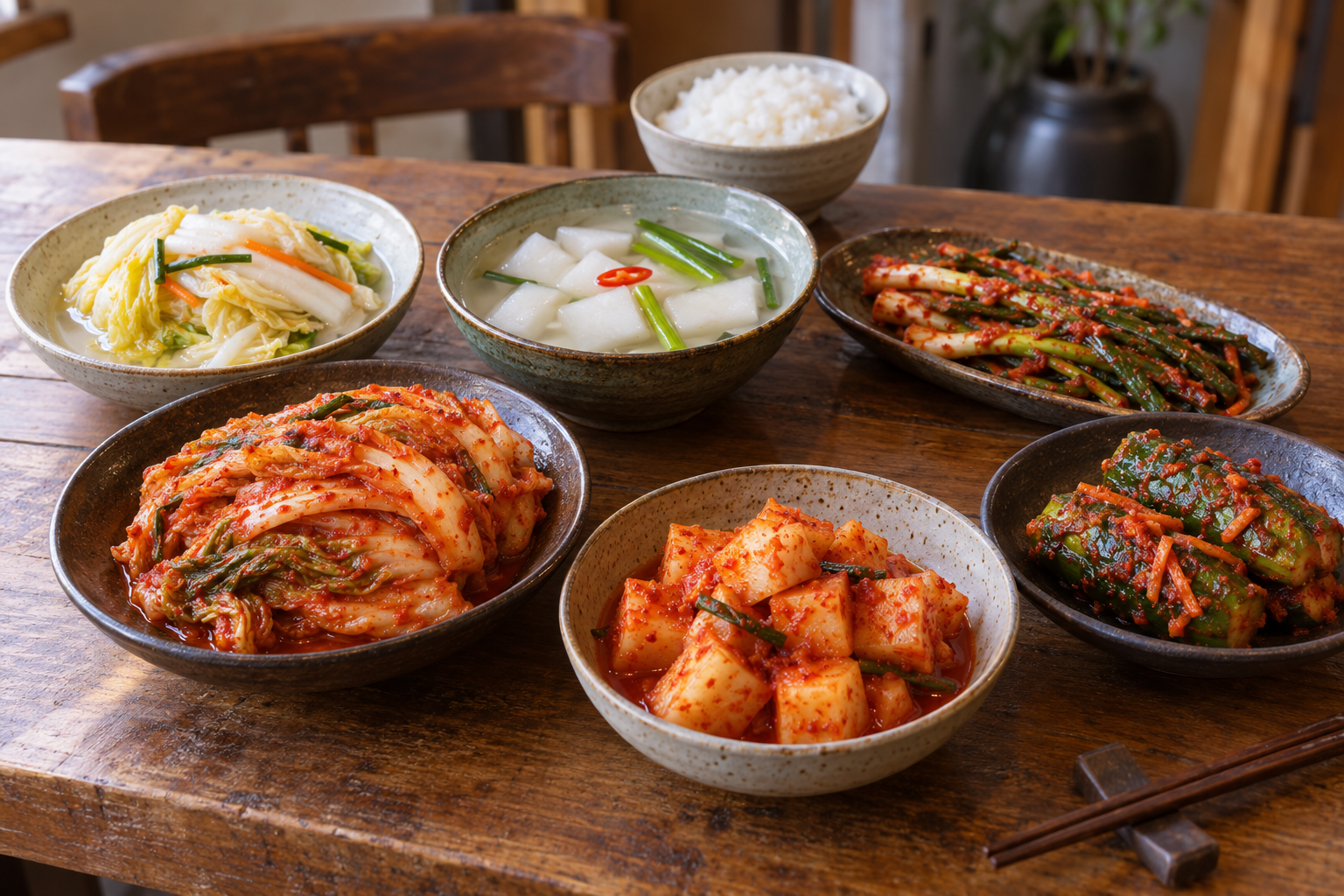
Kimchi is one of the most recognizable foods in Korea. It appears beside grilled meat, soups, noodles, rice dishes, and many everyday meals. For many Koreans, a meal can feel incomplete without it.
International visitors often think of kimchi as spicy fermented cabbage, but kimchi is much more diverse than that description suggests. It can be fresh or deeply fermented, mild or spicy, crisp or tender, and made with cabbage, radish, cucumber, green onions, mustard leaves, and many other vegetables.
Understanding kimchi can help you appreciate not only Korean food but also the traditions, seasons, and shared meals that surround it.
What Is Kimchi?
Kimchi (김치) is a broad category of Korean vegetable dishes that are salted, seasoned, and often fermented.
The best-known variety is baechu kimchi, made with napa cabbage. However, the word “kimchi” does not refer to only one recipe. Different vegetables, seasonings, preparation methods, regions, and fermentation times produce many kinds of kimchi.
Common ingredients may include:
- Napa cabbage
- Korean radish
- Cucumber
- Green onions
- Garlic
- Ginger
- Gochugaru, or Korean red pepper flakes
- Salted seafood
- Fish sauce
- Salt
- Rice paste
Not every kimchi contains all these ingredients. Some varieties contain no red pepper at all, while vegetarian and vegan versions may leave out fish sauce and salted seafood.
Is Kimchi Always Spicy?
No. Many familiar kimchi varieties contain gochugaru and have some heat, but the level of spiciness varies widely.
Some kimchi tastes only mildly spicy because its strongest flavors come from fermentation, garlic, ginger, salt, or seafood seasoning. Other recipes use a generous amount of red pepper and can be noticeably hot.
There are also white and water-based varieties that contain little or no red pepper. Baek kimchi, meaning white kimchi, is generally mild. Dongchimi is a refreshing radish kimchi served in a clear, cool brine.
The red color of kimchi does not always tell you exactly how spicy it will be. A bright red kimchi can taste milder than expected, while a variety containing fresh green chili peppers may be hotter than it looks.
For more information about heat levels in Korean cuisine, see Is Korean Food Spicy? Popular Spicy and Mild Korean Dishes.
What Does Kimchi Taste Like?
Kimchi does not have one single flavor. Its taste depends on the ingredients, recipe, and stage of fermentation.
Freshly prepared kimchi is often:
- Crisp
- Bright
- Salty
- Lightly sweet
- Garlicky
- Fresh-tasting
As it ferments, kimchi generally becomes:
- More sour
- More complex
- Softer in texture
- Stronger in aroma
- Deeper in savory flavor
Some people prefer fresh, crunchy kimchi, while others enjoy a stronger and more sour version. Both are normal stages of kimchi rather than indications that one is necessarily better than the other.
Why Is Kimchi Fermented?
Fermentation changes the flavor, aroma, acidity, and texture of kimchi over time.
Vegetables are first salted, which draws out moisture and helps prepare them for seasoning and preservation. After the vegetables are mixed with seasonings, naturally occurring microorganisms begin the fermentation process.
Freshly made kimchi may taste more like a seasoned vegetable salad. As fermentation continues, it develops the tangy and complex flavor commonly associated with kimchi.
Temperature has a major effect on this process. Kimchi ferments more quickly in a warm environment and more slowly when refrigerated. Many Korean households use a separate kimchi refrigerator designed to maintain stable conditions for storage and fermentation.
Kimchi continues to change after it is made. It is not expected to taste exactly the same every day.
Popular Types of Kimchi
Travelers may encounter several different varieties during a trip to Korea.
Baechu Kimchi
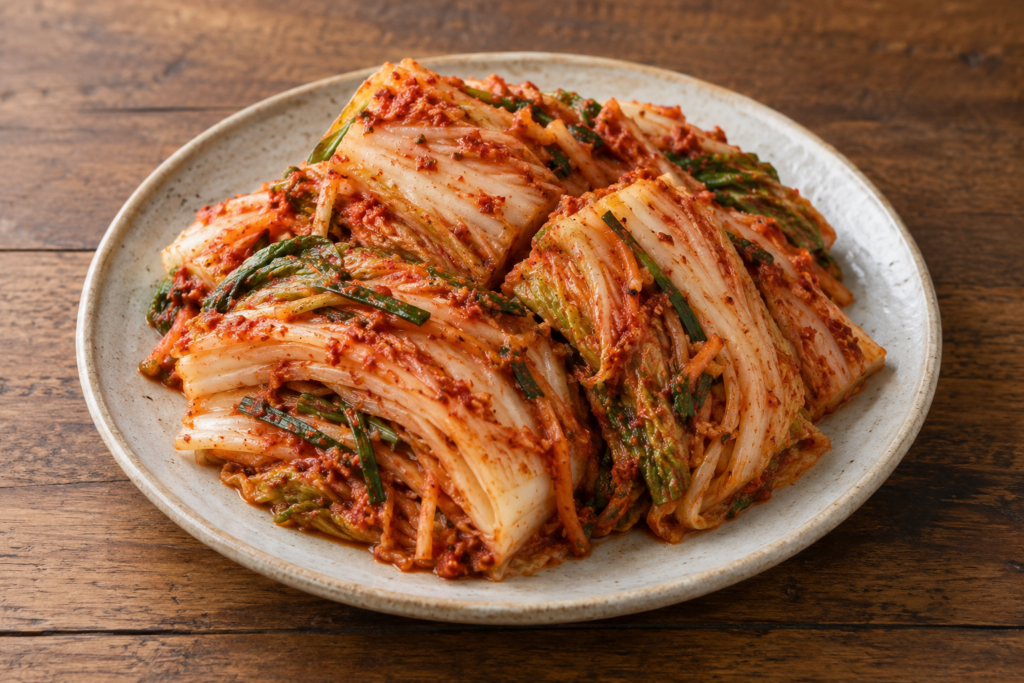
Baechu kimchi (배추김치) is made with napa cabbage and is the variety most people outside Korea recognize.
The cabbage is salted and seasoned with a mixture that commonly includes gochugaru, garlic, ginger, green onions, and fish sauce or salted seafood. Recipes vary by household and region.
Baechu kimchi is frequently served as a side dish and is also used in fried rice, pancakes, dumplings, stews, and other dishes.
Kkakdugi
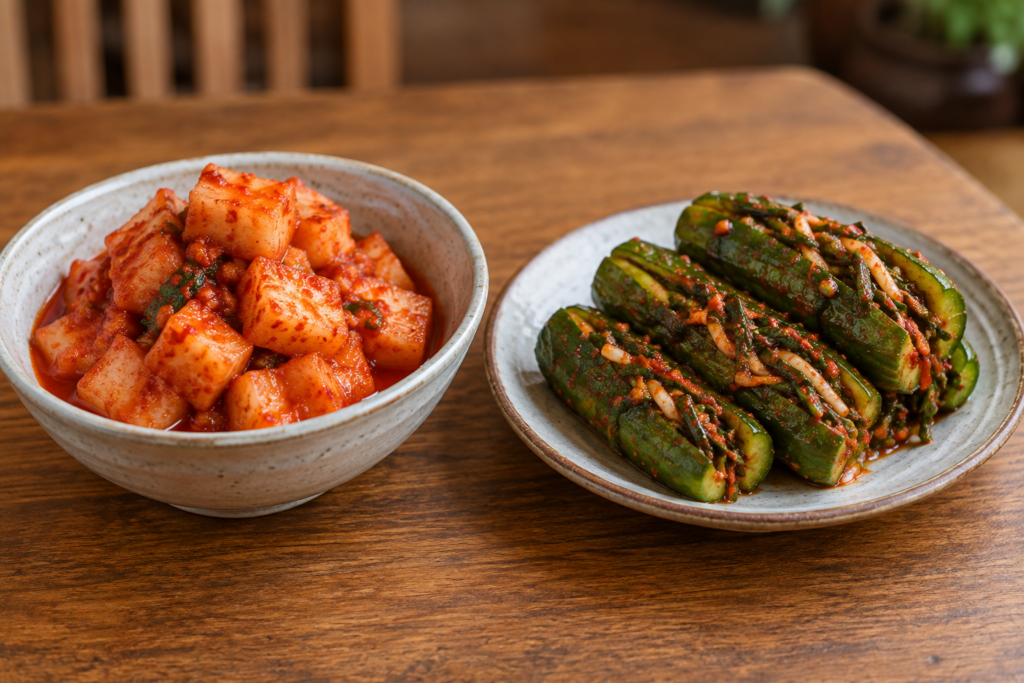
Kkakdugi (깍두기) is made with Korean radish cut into cubes.
It is crunchy, juicy, and usually seasoned with red pepper flakes, garlic, and other ingredients. Kkakdugi is commonly served with mild soups such as seolleongtang and gomtang.
The refreshing crunch and acidity contrast well with rich beef broth.
Oi Sobagi
Oi sobagi (오이소박이) is cucumber kimchi. Cucumbers are cut and filled with a seasoned mixture that may contain garlic, green onions, chives, and red pepper flakes.
It is crisp and refreshing and is especially popular during warmer weather. Because cucumber softens more quickly than cabbage or radish, oi sobagi is often enjoyed while it is relatively fresh.
Baek Kimchi
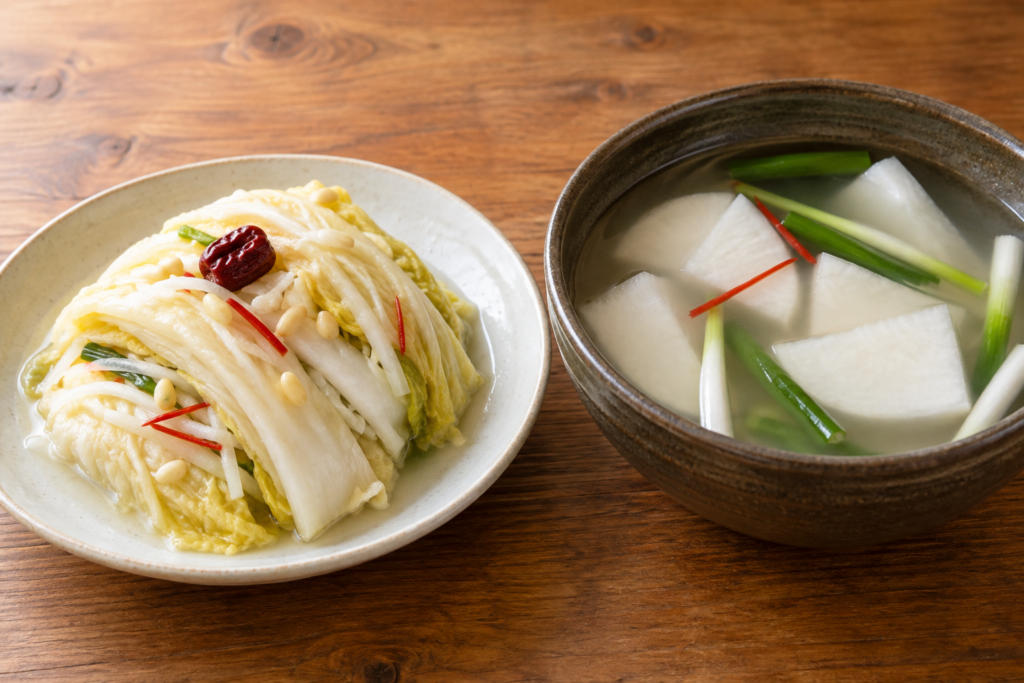
Baek kimchi (백김치), or white kimchi, is made without the usual red pepper seasoning.
It may contain napa cabbage, radish, garlic, ginger, jujubes, chestnuts, or other ingredients, depending on the recipe. Its flavor is generally mild, cool, and lightly tangy.
Baek kimchi can be a good choice for children and travelers who do not tolerate spicy food.
Dongchimi
Dongchimi (동치미) is a water-based radish kimchi served in a clear brine.
It is typically mild, cool, and refreshing. The liquid is an important part of the dish and may be served alongside rich food or used as a base for certain cold noodle dishes.
Dongchimi is traditionally associated with winter, although it can be enjoyed at other times of the year.
Nabak Kimchi
Nabak kimchi (나박김치) is another water-based kimchi. It is usually made with thin, rectangular pieces of radish and napa cabbage in a lightly seasoned pink or reddish brine.
It is generally milder and lighter than heavily seasoned cabbage kimchi.
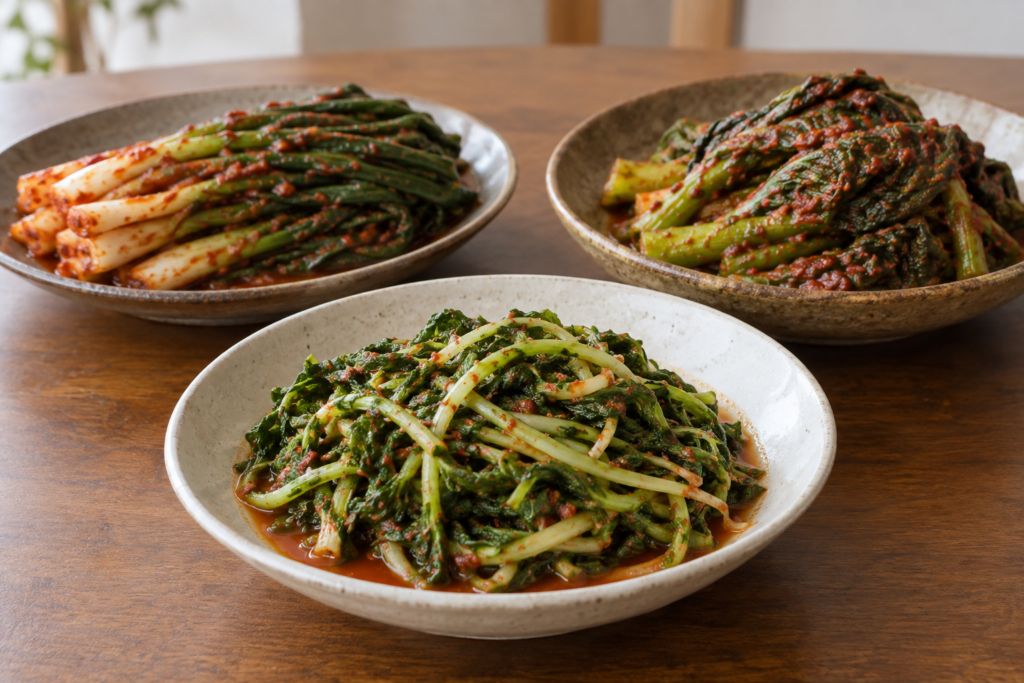
Yeolmu Kimchi
Yeolmu kimchi (열무김치) is made with young summer radish greens.
It has a fresh, slightly earthy taste and is often enjoyed during warm weather. Yeolmu kimchi may be served with rice or added to cold noodles such as bibim guksu.
Pa Kimchi
Pa kimchi (파김치) is made with green onions, often using slender scallions.
It tends to have a stronger flavor than ordinary cabbage kimchi and can be spicy, salty, and deeply savory. It pairs especially well with grilled meat and rice.
Gat Kimchi
Gat kimchi (갓김치) is made with mustard leaves.
It has a distinctive aroma and a slightly bitter, peppery flavor. Yeosu, a coastal city in southern Korea, is particularly well known for this type of kimchi.
Chonggak Kimchi
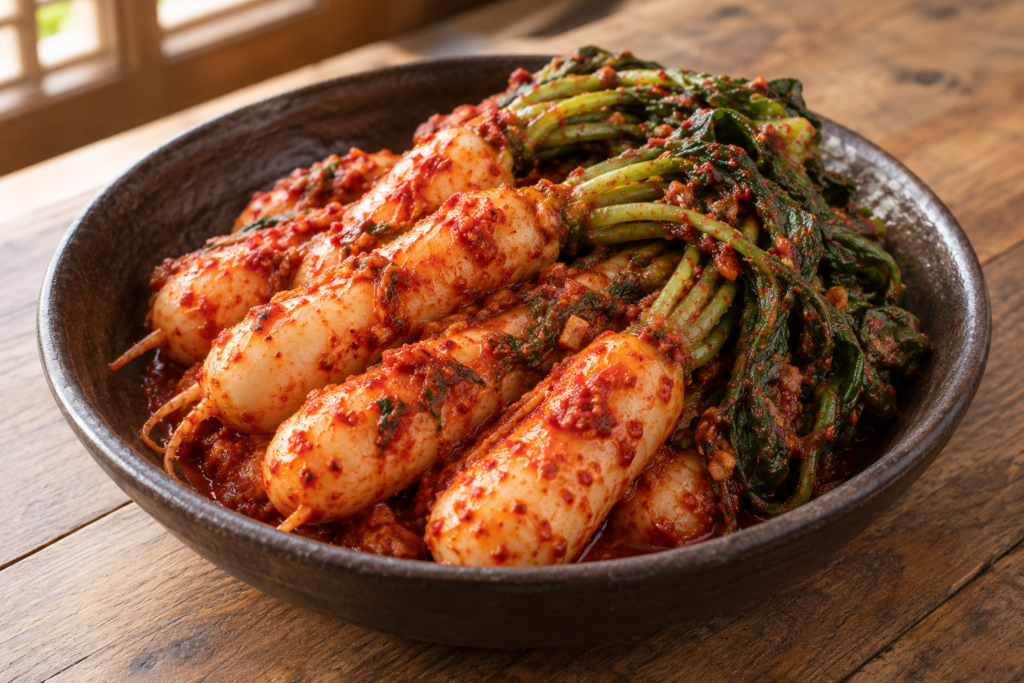
Chonggak kimchi is made with small, elongated Korean radishes and their leafy green tops. The radishes are usually kept whole and coated with a spicy seasoning made from Korean red pepper flakes, garlic, ginger, and fish sauce. After fermentation, they develop a crisp texture and a tangy, savory flavor. Unlike kkakdugi, which is made with cubed radish, chonggak kimchi is known for its crunchy whole radishes and long seasoned leaves.
Geotjeori
Geotjeori (겉절이) is freshly seasoned kimchi intended to be eaten before it develops the deeper sourness of long fermentation.
It is crisp, fresh, and often slightly sweet. Geotjeori pairs especially well with boiled pork, knife-cut noodles, and warm rice.
Although it is often described as fresh kimchi, it differs noticeably from a fully fermented version in both texture and flavor.
Why Does Kimchi Taste Different at Every Restaurant?
Kimchi recipes are not completely standardized. Each restaurant, manufacturer, household, and region may prepare it differently.
The taste may vary because of:
- The amount and type of gochugaru
- Fermentation time
- Storage temperature
- Salt level
- Fish sauce or salted seafood
- Added sweetness
- The vegetable used
- Regional cooking traditions
- Seasonal ingredients
A barbecue restaurant may serve a strong, well-fermented kimchi that tastes good when grilled. A noodle restaurant may offer a fresh and crunchy kimchi. A soup restaurant may serve kkakdugi because its crisp acidity complements a mild broth.
Disliking one restaurant’s kimchi does not necessarily mean that you dislike all kimchi. Another variety may taste completely different.
How Is Kimchi Served in Korea?
Kimchi is normally served as banchan, one of the small shared side dishes placed on a Korean dining table.
At many traditional Korean restaurants, kimchi is included with the meal rather than ordered separately. Basic refills are also commonly available at no additional charge, although restaurant policies can vary.
Kimchi is usually shared by everyone at the table. Take a small portion as you eat rather than treating it as a separate appetizer.
To learn more about Korean side dishes and refills, read What Is Banchan? Are Side Dishes Free in Korea?
How Do Koreans Eat Kimchi?
Kimchi is often eaten in small amounts with rice and a main dish. Its acidity, saltiness, and crisp texture can balance rich, mild, or fatty foods.
Common combinations include:
- Kimchi with rice
- Kkakdugi with seolleongtang
- Kimchi with grilled pork belly
- Fresh geotjeori with boiled pork
- Kimchi with ramyeon
- Kimchi with Korean barbecue
- Dongchimi with cold noodles
There is no required order for eating kimchi. You can alternate between the main dish, rice, soup, and kimchi according to your preference.
Is Kimchi Used Only as a Side Dish?
No. Well-fermented kimchi is widely used as a cooking ingredient.
Popular dishes made with kimchi include:
Kimchi Jjigae
Kimchi jjigae is a hearty stew commonly made with aged kimchi, tofu, green onions, and pork or tuna.
Sour, fully fermented kimchi works especially well because its strong flavor holds up during cooking.
Kimchi Bokkeumbap
Kimchi bokkeumbap is kimchi fried rice. It may include meat, tuna, vegetables, seaweed, or a fried egg.
It is a popular way to use kimchi that has become too sour to enjoy as a simple side dish.
Kimchi Jeon
Kimchi jeon is a savory pancake made with chopped kimchi and batter. It has a crisp exterior and a tangy, slightly spicy flavor.
Kimchi Mandu
Kimchi mandu are dumplings filled with chopped kimchi and other ingredients such as tofu, vegetables, or meat.
Grilled Kimchi
Kimchi is sometimes grilled alongside pork belly at Korean barbecue restaurants. Heat softens the cabbage and creates a deeper, richer flavor.
Older kimchi is not necessarily wasted. Its stronger acidity often makes it better for cooking.
What Is Kimjang?
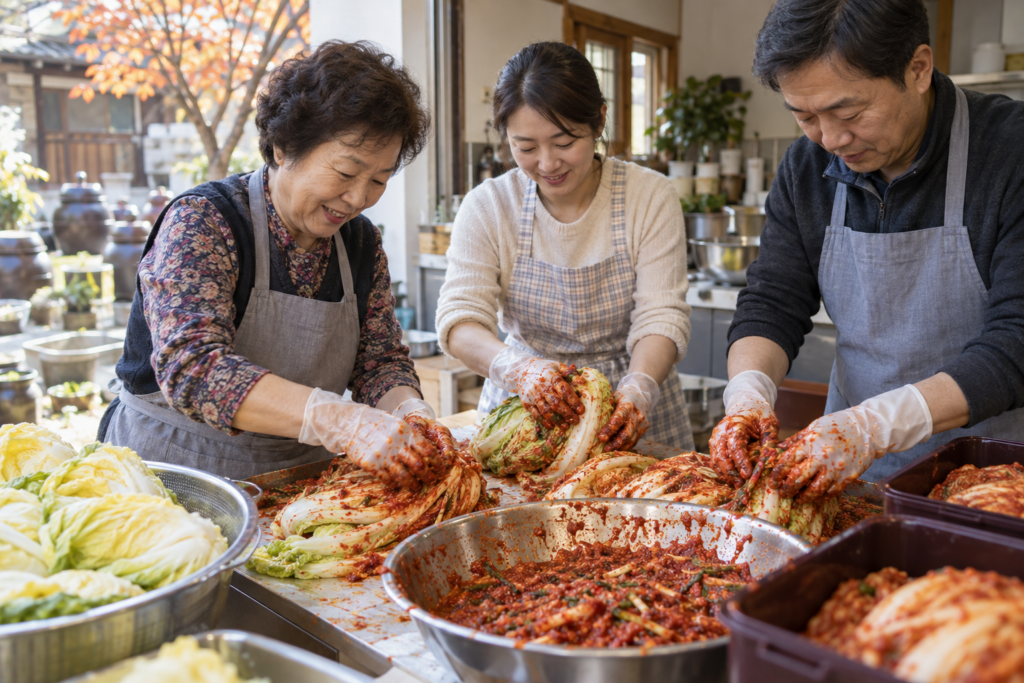
Kimjang (김장) is the tradition of preparing and sharing large quantities of kimchi, traditionally in late autumn before winter.
Families and communities work together to prepare vegetables, season the cabbage, fill containers, and divide the finished kimchi. The practice reflects cooperation, seasonal preparation, and the sharing of food and knowledge across generations.
In 2013, UNESCO added “Kimjang, making and sharing kimchi in the Republic of Korea” to its Representative List of the Intangible Cultural Heritage of Humanity. The recognized cultural tradition is kimjang—the communal practice of making and sharing kimchi—rather than a single kimchi recipe. Learn more from UNESCO.
Modern Korean families may buy kimchi or prepare smaller quantities than in the past, but kimjang remains an important symbol of Korean food culture.
Is Kimchi Vegetarian or Vegan?
Not always.
Many traditional kimchi recipes use ingredients derived from seafood, including:
- Fish sauce
- Salted shrimp
- Salted anchovies
- Other fermented seafood
Kimchi made with these ingredients is not vegetarian or vegan, even when the main ingredient is a vegetable.
Vegetarian and vegan kimchi is available, but travelers should check the label or ask the restaurant instead of assuming.
A useful question is:
“Jeotgal deureogayo?” (젓갈 들어가요?)
This means, “Does it contain salted seafood?”
You can also ask:
“Bigeon kimchi isseoyo?” (비건 김치 있어요?)
This means, “Do you have vegan kimchi?”
At an ordinary restaurant, the staff may not know every ingredient if the kimchi was purchased from a supplier, so people with serious allergies should be especially careful.
Is Kimchi Healthy?
Kimchi is made primarily from vegetables and is often relatively low in calories. Fermented varieties may also contain live lactic acid bacteria.
However, the nutritional content varies by recipe, fermentation stage, processing, and storage. Some commercially packaged kimchi may also be pasteurized, which affects live microorganisms.
Kimchi can contain a significant amount of sodium because salt is essential to its preparation. It is therefore best viewed as a flavorful part of a balanced meal rather than a food that must be eaten in large quantities.
Health claims should not distract from kimchi’s main role: it is an important and flavorful part of Korean cuisine.
How Should Kimchi Be Stored?
Kimchi should generally be kept refrigerated in a tightly closed container.
Because fermentation can continue in the refrigerator:
- The flavor may become more sour over time.
- Liquid may rise inside the container.
- Gas may build up.
- A strong aroma may spread if the container is not sealed well.
Do not fill a storage container completely to the top. Leaving some space can help prevent liquid from overflowing as fermentation continues.
Kimchi refrigerators are common in Korean homes, but travelers and home cooks can use an ordinary refrigerator with a well-sealed container.
Can You Bring Kimchi Home From Korea?
Packaged kimchi is widely sold in supermarkets, department stores, markets, convenience stores, and airport shops.
If you plan to carry it in your luggage:
- Choose factory-sealed packaging.
- Place it inside an additional leak-resistant bag.
- Protect it from being crushed.
- Check your airline’s baggage rules.
- Check the customs and agricultural regulations of your destination.
- Remember that kimchi liquid may be subject to carry-on liquid restrictions.
Rules can vary by country and may change, so confirm current entry requirements before traveling.
Tips for First-Time Kimchi Eaters
If you are trying kimchi for the first time:
- Begin with a small portion.
- Try it with rice rather than eating it alone.
- Pair it with mild soup or grilled meat.
- Try baek kimchi if you avoid spicy food.
- Try geotjeori if you prefer a fresh, crisp texture.
- Try well-fermented kimchi if you enjoy sour flavors.
- Remember that every restaurant’s kimchi can taste different.
Kimchi is meant to complement the rest of the meal. You do not have to eat a large amount to appreciate it.
Final Thoughts
Kimchi is far more than spicy cabbage. It is a broad and diverse part of Korean cuisine made with different vegetables, seasonings, fermentation methods, and regional traditions.
Baechu kimchi may be the most familiar variety, but kkakdugi, oi sobagi, baek kimchi, dongchimi, yeolmu kimchi, pa kimchi, and many other types offer completely different flavors and textures.
Kimchi can be fresh or fermented, mild or spicy, served as a side dish or cooked into an entirely new meal. It also carries cultural meaning through kimjang, the tradition of preparing and sharing kimchi as a community.
Trying several kinds is the best way to understand why kimchi remains such an essential part of Korean food and daily life.